
Natural stone brings character, depth and lasting value to an interior.
However, no two types of stone behave in exactly the same way.
Marble, granite, limestone and quartzite each have their own appearance, properties and maintenance requirements. Selecting the right stone should therefore involve more than choosing a colour or pattern.
Understanding the differences between these materials can help architects, designers and contractors select a stone that meets both the design intent and the practical requirements of a project. Which natural stone should you choose?
What is marble?
Marble is a metamorphic stone formed when limestone is transformed by heat and pressure. This process creates the veining, movement and crystalline character for which marble is known.
Its visual impact makes it a popular choice for prestigious interiors, including entrance areas, reception desks, feature walls, bathrooms and statement floors.
Marble is available in a wide variety of colours and can be produced in several finishes, including polished, honed and textured surfaces.
Although marble is durable, it is generally softer than granite and quartzite. As a calcium-based stone, it can also react with acidic substances.
Lemon juice, vinegar and certain cleaning products can leave dull marks known as etching, particularly on polished surfaces. Appropriate sealing, stone-safe cleaning products and suitable maintenance procedures are therefore important.
Best suited to: projects where distinctive veining, refinement and natural variation are central to the design.
What is granite?
Granite is an igneous rock formed when molten material slowly cools beneath the Earth’s surface. It has a dense, crystalline structure and is usually recognisable by its granular or speckled appearance.
It is one of the hardest natural stones commonly used in construction. Its resistance to scratching, impact and heavy wear makes it a reliable choice for busy commercial environments.
Subject to the properties of the particular stone and its selected finish, granite may also be suitable for external applications.
Granite is generally less absorbent than marble or limestone, although porosity varies between individual materials. Some granites benefit from sealing.
The selected finish should always be considered in relation to the location, expected traffic, slip resistance and cleaning requirements.
Best suited to: high-traffic environments that require robust performance and relatively straightforward maintenance.
What is limestone?
Limestone is a sedimentary rock formed from accumulated mineral and organic material. Depending on its origin, it may contain fossils, shells or other subtle natural markings.
These characteristics give limestone a warm, understated appearance.
It is commonly available in cream, beige, grey and earthy tones natural tones and works particularly well in schemes that require a calm and cohesive finish. Limestone can complement traditional architecture as well as minimal, contemporary interiors.
Limestone is generally softer and more porous than granite and quartzite. Like marble, it is calcium-based and can be affected by acidic substances.
Selecting an appropriate finish and sealer — and following the correct maintenance regime — can help protect its appearance.
Best suited to: interiors and carefully specified external schemes where warm colours, texture and a subtle natural finish are desired.
What is quartzite?
Quartzite is a natural metamorphic stone created when quartz-rich sandstone is subjected to intense heat and pressure. The resulting material is exceptionally hard and often has a crystalline appearance.
Some quartzites feature flowing patterns and veining that resemble marble. This makes them attractive for projects where a dramatic natural appearance and strong performance are both required.
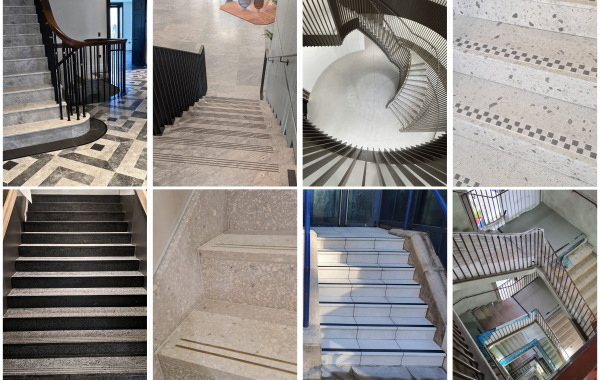
Their hardness makes quartzites suitable for demanding applications such as floors, stairs, worktops and other frequently used surfaces, subject to the properties of the individual stone.
Quartzite should not be confused with engineered quartz. Quartzite is quarried natural stone. Engineered quartz is a manufactured product made using quartz particles, resin and pigments.
It is also important to verify that a product sold as quartzite is a true quartzite, as commercial names do not always reflect a stone’s geological classification.
Best suited to: demanding applications where hardness, durability and striking natural movement are priorities.
The key differences
Appearance
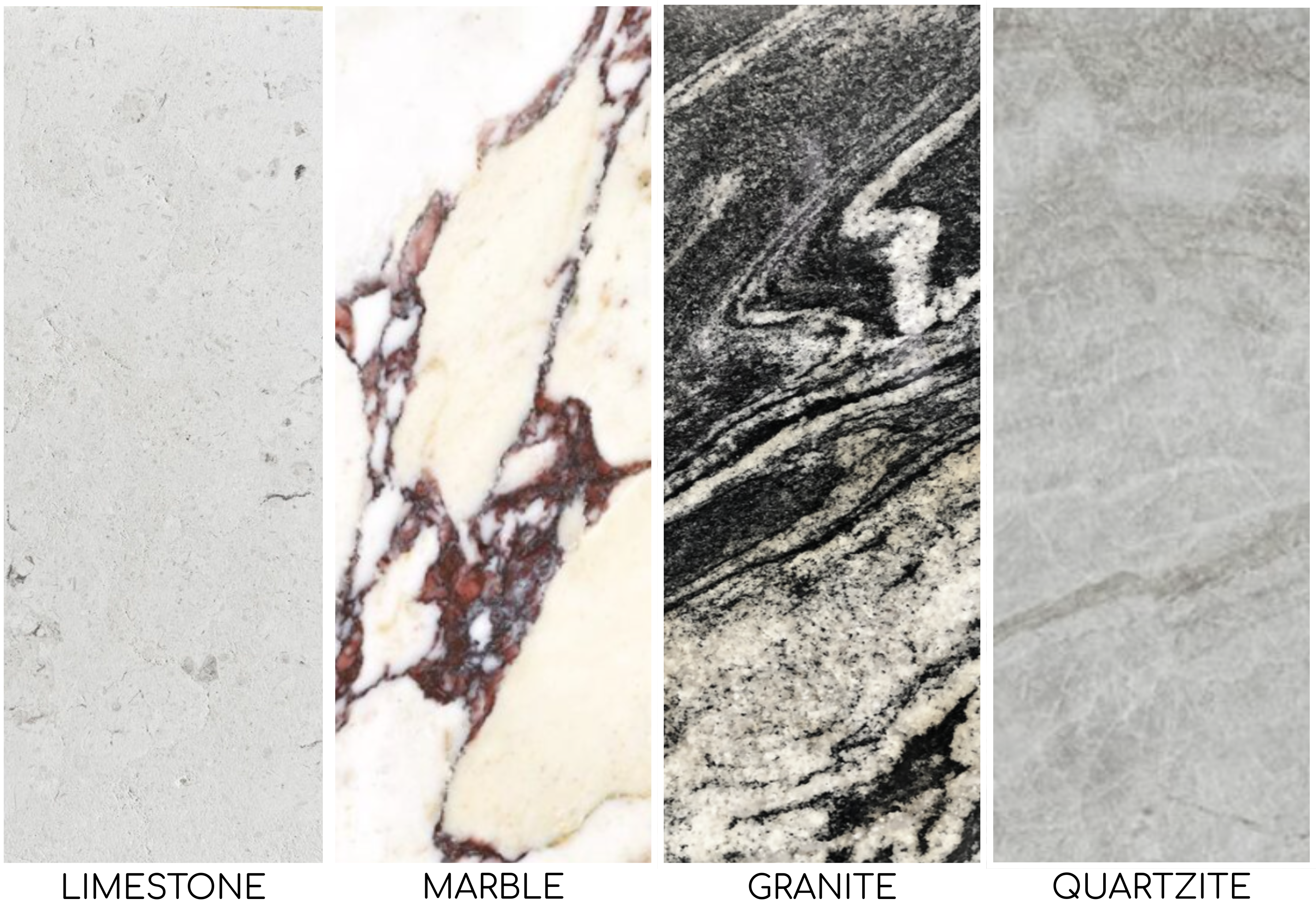
Marble is known celebrated for its expressive veining, while granite normally has a more granular or speckled structure.
Limestone tends to provide softer tonal movement and may include visible fossils. Quartzite frequently has a crystalline appearance and can display dramatic, marble-like patterns.
Every slab of natural stone is unique. A small sample will only provide a general indication of the final appearance.
For large or visually important areas, it is advisable to review the available slabs or a representative range before confirming the material.
Hardness and resistance to wear
Granite and quartzite are generally the hardest of these four materials and are often selected for high-use areas.
Marble can provide excellent service when it is specified, installed and maintained correctly. However, it is more susceptible to scratching and etching.
Limestone is normally the softest of the four and requires greater consideration when proposed for heavily trafficked locations.
Porosity and staining
Porosity varies not only between different families of stone but also between individual varieties.
Limestone and marble are commonly more absorbent, while many granites and quartzites are denser. However, a specification should never be based solely on the general name of the stone.
Technical information and testing should be used to determine its suitability and the need for sealers or specialist maintenance products.
Finish and slip resistance
The selected finish can significantly change both the appearance and performance of natural stone.
A polished finish enhances the stone’s colour, veining and reflection. A honed finish provides a softer, matt appearance, while textured finishes can offer additional grip where required.
Slip resistance should be assessed for the specific material, finish and conditions of use. This is particularly important in entrances, wet areas, external spaces and other locations where the floor may become wet.
Maintenance
Every natural stone installation benefits from an appropriate care and maintenance plan.
Neutral, stone-safe cleaning products are normally recommended. Acidic or abrasive cleaners should be avoided on acid-sensitive materials such as marble and limestone.
Sealers do not make a surface completely stain-proof, but they can provide additional time to clean spillages before they penetrate the stone.
Which natural stone should you choose?
There is no single material that is suitable for every project. The right choice depends on several factors:
- The location and expected level of foot traffic
- Whether the installation is internal or external
- Exposure to water, food, chemicals or staining agents
- Required slip resistance
- Expected cleaning and maintenance procedures
- Desired colour, pattern, movement and finish
- Substrate, stone thickness and installation system
- Budget, material availability and project programme
Early collaboration between the design team, stone supplier and specialist installer can help prevent performance issues and ensure that the finished installation supports the original design intent.
Specialist natural stone installation
At Avantgarde Tiling, we work with architects, designers and contractors to deliver bespoke natural stone packages across commercial, retail and high-end interior projects.
Our experience includes natural stone flooring, wall finishes, staircases, vanity units and individually manufactured architectural elements.
From material and finish considerations through to technical coordination and installation, our team can help transform a natural stone specification into a carefully executed finished surface.
Planning a project involving marble, granite, limestone or quartzite? Contact Avantgarde Tiling to discuss your requirements.